Habitat for Humanity Vancouver Island North is changing course on its Campbell River property to get families into homes sooner.
Habitat for Humanity Vancouver Island North has made the decision to sell its one-acre property in Campbell River and redirect the proceeds toward acquiring a smaller property that can support a more immediate, achievable build.
When we acquired the property, we saw an exciting opportunity to create a larger Habitat development, potentially providing homes for approximately 20 families. Habitat has successfully completed larger developments in both Campbell River and Courtenay, and we know that this kind of project can make a tremendous difference for families.
But the economics of building have changed significantly.
Construction costs have risen sharply in recent years, alongside the cost of labour, materials and other inputs required to build new homes. Across Canada, the cost of constructing residential buildings has risen substantially since 2020, and BC continues to experience elevated construction costs.
As we've worked through the realities of developing the Campbell River property today, it has become clear that a project of this scale would require an estimated $12–15 million and could take several years to bring to completion.
We don't want to wait that long.
We are in the middle of a housing crisis, and every year that we spend fundraising for a large development is another year that families are waiting for a safe, stable and affordable place to call home. So, we are pursuing a smaller property where we can build on a more achievable timeline. The exact number and configuration of homes will depend on the property we ultimately acquire and the applicable approvals, but our goal is simple: get families into homes sooner.
This is not a step backwards. It is a decision to move forward. We need to be strategic about how we use the resources entrusted to us by our donors, volunteers and community partners. The decision to sell the Campbell River property allows us to put our resources toward a project that has a clearer and faster path to construction. It doesn't change our commitment to Campbell River. It changes how we intend to deliver on that commitment.
Habitat is in the business of building homes. We want to build, learn, build again and keep that momentum going. And we already have that momentum. Habitat VIN has land in Courtenay and Comox that will support future projects, and we are actively working toward getting those builds underway as well.
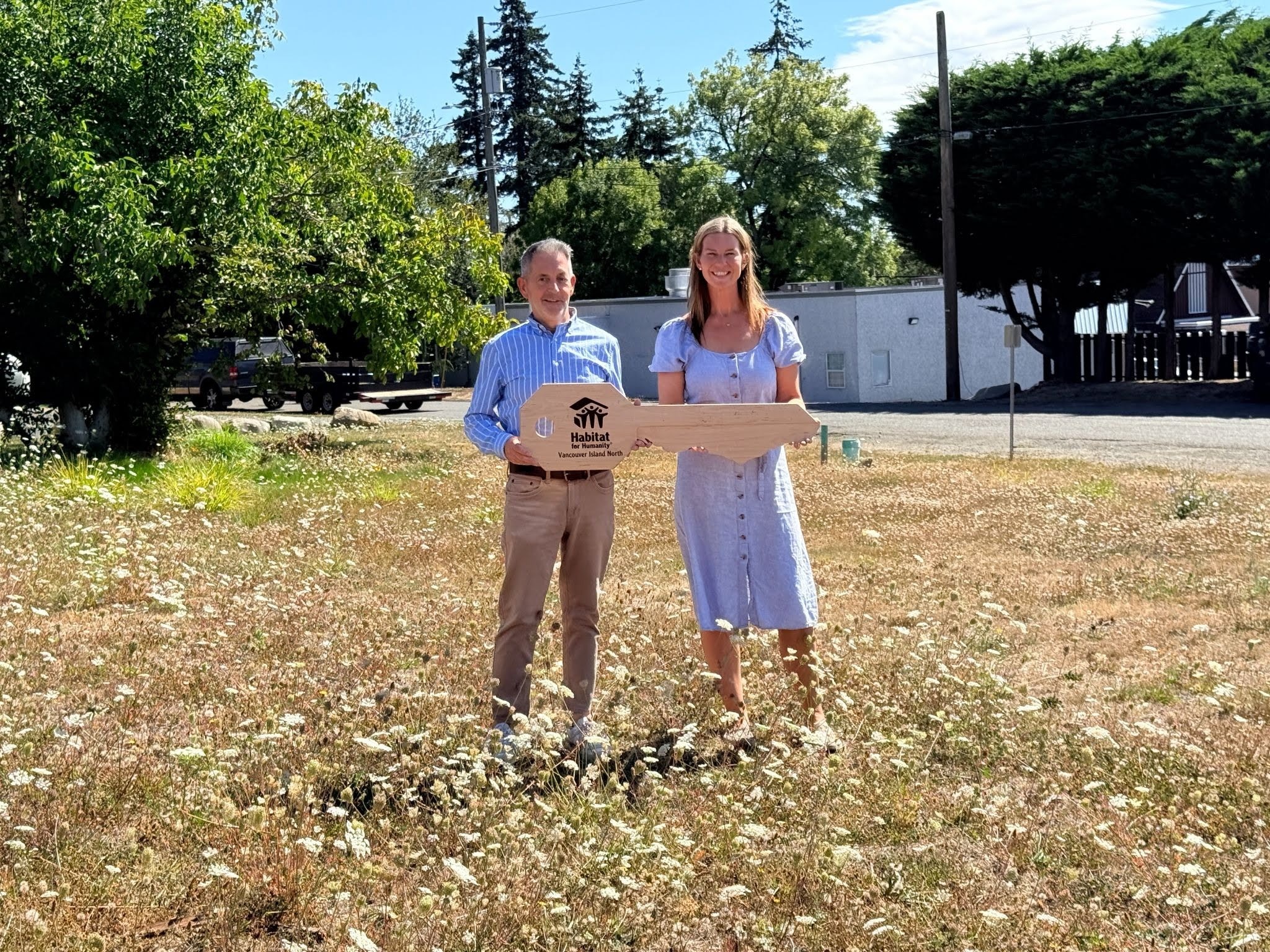
We know some people may have become attached to the idea of Habitat homes being built on this particular property, especially after seeing our sign there. We understand that. When we put that sign up, we fully intended to pursue a Habitat development on the property. As we learned more about the cost and complexity of developing the site, we made the responsible decision to change course.
The location has never been the mission. The mission is helping local families achieve affordable homeownership.
That mission hasn't changed. If anything, this decision reflects our commitment to it.
We are choosing progress over waiting. We are choosing achievable over aspirational. And we are choosing to get families into homes sooner. We're not stepping back from building - we're getting building.
“But you've built larger developments before. Why can't you do that now?”
Answer: We have, and we're proud of those projects. But the cost of building has changed significantly. Construction costs, labour and materials are all more expensive than they were when those projects were developed. The economics of a 20-home development simply look very different today.
That doesn't mean Habitat can't build. It means we need to be strategic about what we build and how quickly we can build it.
“So is Habitat saying large developments aren't possible anymore?”
Answer: Not at all. We're saying that, in the current economic environment, a large development requires significantly more capital and a much longer timeline. We don't think families should have to wait years while we raise that level of funding when there are opportunities to build on a smaller scale sooner.
“Why didn't you know construction would be this expensive when you bought the property?”
Answer: Construction costs and economic conditions change, and the true cost and complexity of a development become clearer as you move through planning, design and feasibility work.
When we acquired the property, we saw the potential for a significant Habitat development. We have since learned what it would take to deliver that vision under today's conditions. We have a responsibility to respond to that information rather than continue down a path simply because it was our original plan.
“Didn't Habitat promise 20 families homes?”
Answer: The property offered the potential for a much larger development, and we were excited about that possibility. But the number of homes was never a guarantee. As we have worked through the project's feasibility and current construction costs, we've determined that a smaller project offers a more realistic path to getting families into homes sooner.
“Isn't four homes a pretty small impact compared with 20?”
Answer: We absolutely want to help as many families as possible. But we also have to consider how long it takes to make those homes happen.
Our choice is between spending potentially five years raising $12–15 million for one large project, or using our resources to get a smaller project underway sooner while continuing to build our pipeline elsewhere.
“Does this mean you're abandoning the bigger vision?”
Answer: No. We're adapting to the realities of today's construction environment. Habitat has built larger developments before, and we may do so again when the circumstances make sense. Right now, our priority is getting projects moving and creating momentum.
“Why should donors believe you'll actually build the next project?”
Answer: Because we're not starting from scratch. We have land in Courtenay and Comox and active projects in our pipeline. This decision is about making our Campbell River project more achievable, not stepping away from construction.